If your website isn’t ranking the way it should, chances are the issue isn’t your content quality, it’s missing pieces in your on-page foundation. This on-page SEO checklist walks through every element Google actually evaluates when deciding how to rank a page, from title tags to technical structure, so you can systematically fix what’s holding your site back.
Whether you’re managing a single business website in Kochi or overseeing multiple pages across a GCC-facing site, this guide gives business owners, marketers, and website managers a clear, step-by-step reference to optimize every page for stronger Google visibility.
Why an On-Page SEO Checklist Matters More Than Ever
Search engines have grown increasingly sophisticated at evaluating page quality, but the fundamentals of on-page optimization remain surprisingly consistent. What’s changed is the margin for error; with AI-driven search features and increasingly competitive SERPs, pages with incomplete or inconsistent on-page signals simply don’t compete as effectively as they once did.
Working through a structured on-page SEO checklist ensures nothing critical slips through, whether you’re optimizing a new page from scratch or auditing existing content that’s underperforming.
On-Page SEO Optimization Guide: Where to Start
A solid on-page SEO optimization guide begins with understanding the two categories your work falls into: content-based factors (what the page says) and technical factors (how the page is built). Both matter equally, and neglecting either one limits how well even excellent content can perform.
Before diving into individual checklist items, it helps to audit your current page against both categories to identify where the biggest gaps exist, rather than making changes randomly without a clear sense of priority.
SEO Checklist for Websites: The Core Elements
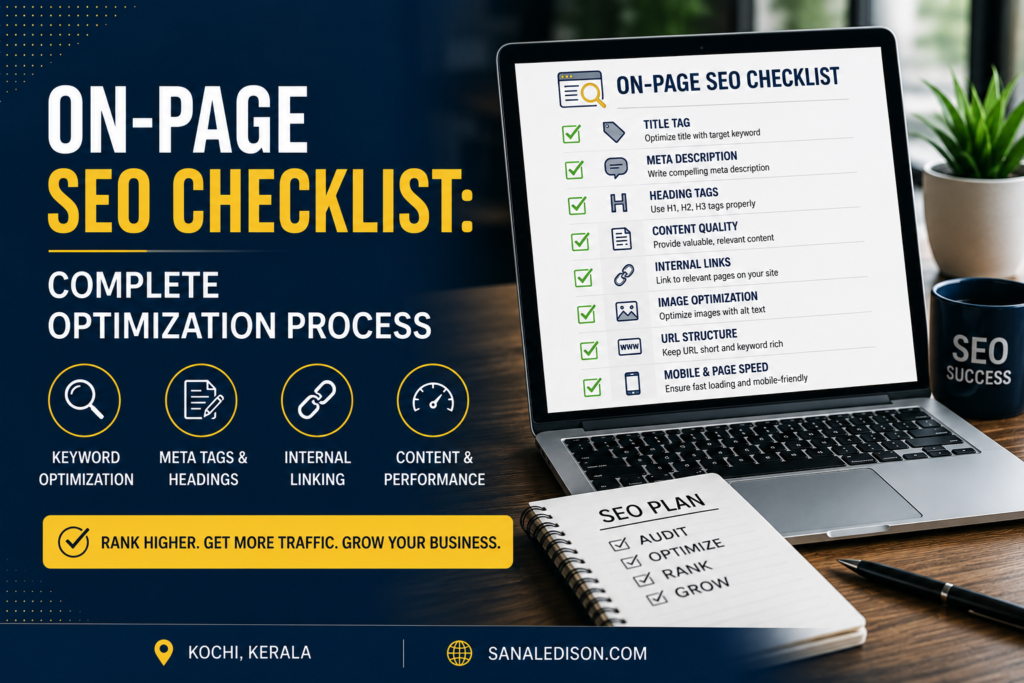
Every SEO checklist for websites should cover these foundational elements, regardless of industry or page type:
- Title tag — Include your primary keyword naturally, ideally near the beginning, and keep it under 60 characters.
- Meta description — Write a compelling 150-160 character summary that includes your primary keyword and encourages clicks.
- URL structure — Keep URLs short, descriptive, and keyword-relevant, avoiding unnecessary parameters or dates.
- Header hierarchy — Use a single H1 per page, followed by logically structured H2s and H3s.
- Image optimization — Compress images for fast loading and use descriptive alt text with relevant keywords where natural.
- Internal linking — Connect related pages using descriptive anchor text, not generic phrases like “click here.”
Working through this list systematically for every important page on your site creates a consistent foundation across your entire domain.
On-Page Ranking Factors: What Google Actually Weighs
Understanding on-page ranking factors helps prioritize where to focus your effort. Google’s algorithm considers keyword relevance and placement, content depth and quality, page loading speed, mobile usability, and how well the content actually satisfies the search intent behind a given query.
Increasingly, on-page ranking factors also include signals related to E-E-A-T (Experience, Expertise, Authoritativeness, Trustworthiness), meaning content that demonstrates genuine expertise and credibility tends to outperform thin or generic pages, even when keyword optimization is technically similar.
Content Optimization Checklist: Making Your Copy Work Harder
A thorough content optimization checklist ensures your actual written content, not just the technical wrapper around it, is pulling its weight. Key items include:
- Naturally placing your primary keyword in the first 100 words, at least one subheading, and throughout the body at a reasonable density
- Answering the specific search intent behind the target query, not just mentioning the keyword
- Breaking content into short, scannable paragraphs with clear subheadings
- Including semantic and related keywords (LSI terms) that reinforce topical relevance
- Adding genuinely useful examples, data, or insights that go beyond surface-level information
Pages that read naturally for humans first, while still hitting these technical markers, consistently outperform content written primarily to satisfy an algorithm.
Technical On-Page SEO: The Elements Users Don’t See
Technical on-page SEO covers the structural elements that affect how search engines crawl, index, and evaluate your page, even though visitors rarely notice them directly. This includes proper schema markup, clean HTML structure, mobile responsiveness, and page loading speed, particularly Core Web Vitals metrics that Google actively factors into rankings.
Neglecting technical on-page SEO can undermine even the best-written content, since a slow, poorly structured page sends negative quality signals regardless of how strong the copy itself is. A complete technical SEO audit covers these technical elements in far greater depth, including specific tools and diagnostic steps for identifying hidden issues.
Keyword Optimization Checklist: Getting Placement Right
A focused keyword optimization checklist helps you avoid both under-optimization and keyword stuffing, two common mistakes that hurt performance in opposite directions. Effective keyword optimization includes:
- Primary keyword in the title tag, H1, and first 100 words
- Secondary and semantic keywords distributed naturally throughout subheadings and body content
- Keyword density generally kept between 1 and 2 percent to avoid appearing manipulative
- Location-specific keywords included where relevant for local businesses targeting Kochi, Ernakulam, or GCC markets specifically
Over-optimizing for a single keyword phrase, repeating it unnaturally throughout the page, often does more harm than good, since modern algorithms are specifically designed to detect and penalize this pattern.
Meta Tags Optimization: Small Details, Real Impact
Meta tags optimization might seem like a minor checklist item, but title tags and meta descriptions directly influence both rankings and click-through rates from search results. Every page should have a unique title tag and meta description, since duplicate or missing meta tags across multiple pages confuse search engines about which page to prioritize for a given query.
Beyond the basics, ensure your meta tags accurately reflect page content, since misleading tags that don’t match the actual page can increase bounce rates, a signal that can indirectly hurt rankings over time.
Website SEO Audit Steps: Reviewing What’s Already Live
Running through website SEO audit steps periodically, rather than only optimizing new content, helps catch issues that develop over time, broken links, outdated meta tags, or content that’s fallen behind competitors. A basic audit process includes:
- Reviewing current rankings and organic traffic trends for key pages
- Checking for broken internal and external links
- Auditing page speed and mobile usability
- Confirming all pages have unique, optimized title tags and meta descriptions
- Identifying thin or outdated content that needs expansion or refreshing
Businesses working with a dedicated local SEO strategy for Kochi-based visibility often combine this on-page audit process with local citation consistency checks, since both factors work together to influence overall search performance.
On-Page SEO Best Practices 2026: What’s Changed
On-page SEO best practices 2026 reflect a few notable shifts from previous years. Content increasingly needs to satisfy both traditional search engines and AI-driven answer engines, meaning clear, direct answers early in your content, structured FAQ sections, and well-organized headers matter more than ever for visibility across both search formats.
Mobile-first indexing remains standard, and page experience signals, including Core Web Vitals, continue carrying real ranking weight, making technical performance inseparable from content quality in any modern optimization strategy.
SEO Content Optimization Guide: Bringing It All Together
A complete SEO content optimization guide ties together everything covered in this checklist: technical foundation, keyword strategy, content depth, and meta tag accuracy, all working together rather than in isolation. Treating on-page SEO as a one-time task rather than an ongoing process is one of the most common mistakes businesses make; search algorithms evolve, competitors improve their own pages, and content that ranked well a year ago can quietly slip without regular review.
Learning more about a structured, ongoing approach to search visibility through Sanal Edison’s background and methodology can help you understand what a consistent, long-term optimization process actually looks like in practice.
Frequently Asked Questions
1. How often should I review my on-page SEO checklist for existing pages?
Reviewing key pages every 3 to 6 months is generally recommended, though high-traffic or competitive pages may benefit from more frequent audits to catch ranking drops early.
2. What’s the single most important item on an on-page SEO checklist?
While every element contributes, ensuring your content genuinely satisfies search intent behind the target keyword tends to have the most significant overall impact on rankings.
3. Does keyword density still matter for on-page SEO in 2026?
Yes, though the focus has shifted from rigid percentages to natural, contextual keyword use; staying within a 1-2% range while prioritizing readability remains a reliable guideline.
4. Can technical SEO issues undo good content optimization?
Yes, slow loading speeds, poor mobile usability, or crawl errors can significantly limit how well even excellent, well-optimized content performs in search results.
5. Is on-page SEO enough on its own, or do I need off-page strategies too?
On-page SEO forms the essential foundation, but it works best combined with off-page factors like backlinks and local citations for a complete, sustainable search strategy.
Final Thoughts on Your On-Page SEO Checklist
Working through a complete on-page SEO checklist systematically, rather than tackling elements randomly, ensures your website builds a genuinely strong foundation for search visibility. Combining technical precision with content that authentically serves your audience’s needs is what separates pages that rank consistently from those that struggle despite significant effort.
Sanal Edison – SEO Expert Kerala
35/2262, Kattiparambil House, Church Road, Palarivattom, Kochi – 682025
Phone: +91 8590595811 | Email: sanal@teknoppy.com