Traffic without conversions is one of the most frustrating problems in e-commerce, and more often than not, the culprit isn’t your ads or SEO, it’s the product page itself. Product page optimization is where visitors actually decide whether to buy, and even small friction points, unclear pricing, weak images, buried shipping information, can quietly cost you sales you worked hard to earn.
This guide walks e-commerce store owners and online retailers through the specific elements that turn browsers into buyers, covering design, content, and technical optimization tactics that genuinely move the needle on conversions.
Why Product Page Optimization Deserves More Attention
Most e-commerce businesses invest heavily in driving traffic through ads, SEO, and social media, but far less attention goes into what happens once a visitor actually lands on a product page. This imbalance means many stores are effectively pouring money into acquisition while leaving conversion potential on the table.
A well-optimized product page doesn’t just look better, it directly addresses the specific hesitations and questions a buyer has in that moment, removing friction at exactly the point where purchase decisions are made.
Product Page Conversion Rate: What “Good” Actually Looks Like
Understanding your product page conversion rate starts with knowing what benchmarks are realistic for your industry. E-commerce conversion rates typically range between 1 and 4 percent depending on product category, price point, and traffic source, meaning even modest improvements can translate into meaningful revenue gains at scale.
Tracking conversion rate at the individual product page level, rather than only looking at site-wide averages, helps identify which specific pages are underperforming and need focused attention rather than generic, site-wide changes.
E-commerce Product Page Design: First Impressions Matter
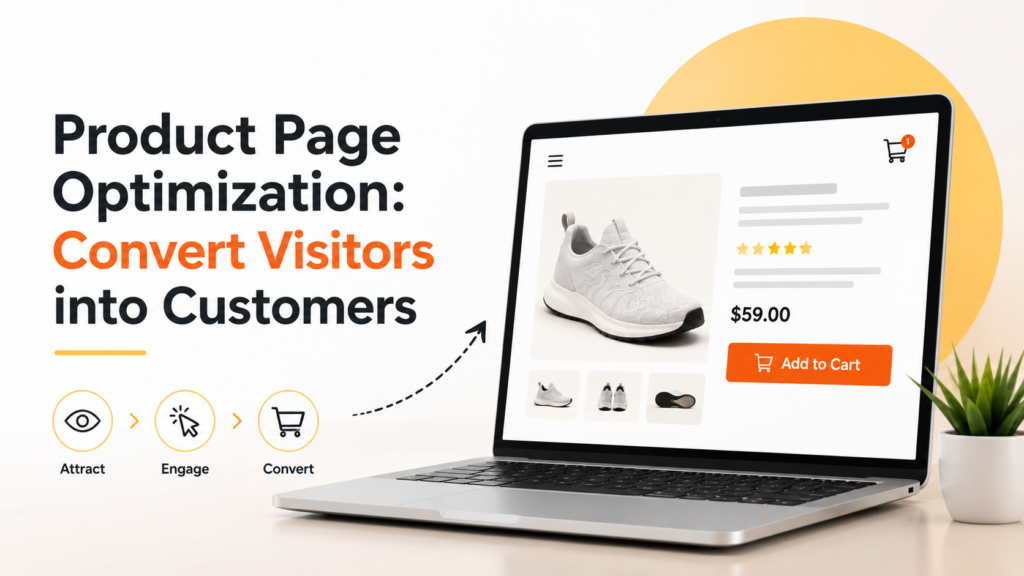
E-commerce product page design shapes a visitor’s trust and buying confidence within seconds of landing on the page. Clean layouts with clear visual hierarchy, prominent pricing, and an unmistakable call-to-action button consistently outperform cluttered pages trying to communicate too much at once.
Mobile responsiveness is particularly critical here, since a growing share of e-commerce traffic across Kerala and GCC markets now comes from mobile devices, meaning a design that works beautifully on desktop but breaks down on smaller screens directly costs conversions.
Product Page Best Practices: The Core Checklist
These product page best practices consistently appear across high-converting e-commerce sites:
- Clear, benefit-focused headline that immediately communicates what the product does for the buyer
- High-quality images showing the product from multiple angles, ideally with zoom functionality
- Transparent pricing with no hidden fees revealed only at checkout
- Visible trust signals, including reviews, ratings, and secure payment badges
- A single, unmistakable call-to-action rather than competing buttons pulling attention in different directions
- Clear shipping and return policy information displayed prominently, not buried in a separate page
Working through this checklist systematically for your top-selling products often reveals quick wins that can be implemented within days, not months.
How to Optimize Product Pages: A Step-by-Step Approach
Understanding how to optimize product pages effectively starts with identifying your biggest friction points before making changes. A practical approach includes:
- Reviewing analytics to identify pages with high traffic but low conversion rates
- Watching session recordings or heatmaps, where available, to see exactly where visitors hesitate or drop off
- Testing one significant change at a time, rather than overhauling everything simultaneously, to isolate what actually moves the needle
- Gathering direct customer feedback about what information they wished was clearer before purchasing
This systematic approach avoids the common mistake of making sweeping changes based on assumptions rather than actual visitor behavior.
Product Page CRO: Testing What Actually Works
Product page CRO (conversion rate optimization) relies on structured testing rather than guesswork. A/B testing individual elements, headline wording, button color, image order, price display format, helps identify which specific changes genuinely influence buying decisions for your particular audience, rather than assuming best practices from other industries will automatically apply.
Even without formal A/B testing tools, tracking conversion rate changes before and after specific updates gives you directional insight into what’s working, particularly useful for smaller stores without the traffic volume for statistically significant split tests.
Product Description Optimization: Selling, Not Just Listing
Product description optimization goes far beyond listing specifications. The strongest descriptions lead with the core benefit or problem the product solves, then support that with specific features and details that build confidence in the purchase decision.
Avoid generic, manufacturer-supplied descriptions copied directly across multiple retailers, since this not only fails to differentiate your store but can also hurt search rankings due to duplicate content. Writing original, benefit-focused descriptions tailored to your specific audience, whether that’s a Kochi-based customer base or broader GCC shoppers, genuinely improves both conversions and organic visibility.
Product Image Optimization: Visual Trust Signals
Product image optimization directly affects both conversion rates and page performance. High-resolution images that clearly show product details build buyer confidence, while poorly lit, low-resolution, or overly edited photos raise subtle doubts about product quality or listing legitimacy.
Beyond visual quality, technical optimization matters too, compressing images for fast loading without sacrificing clarity, since slow-loading pages directly increase bounce rates before visitors even see your product properly.
Product Page SEO: Getting Found Before You Can Convert
Product page SEO determines whether potential customers find your product page at all before conversion optimization even comes into play. This includes optimizing title tags and meta descriptions with relevant keywords, structuring URLs clearly, and using schema markup to enable rich snippets like star ratings and pricing directly in search results.
Applying the same fundamentals covered in our complete on-page SEO checklist to individual product pages, rather than just your homepage or category pages, ensures every page in your store has a genuine chance to rank and drive organic traffic.
Increase E-commerce Conversions: Beyond the Product Page Itself
While this guide focuses on product pages specifically, efforts to increase e-commerce conversions work best as part of a broader strategy. Fast site-wide loading speed, clear navigation, and consistent trust signals across your entire store all reinforce the confidence you’re building on individual product pages.
Businesses combining strong product page optimization with a broader local SEO strategy often see compounding benefits, since improved organic visibility brings in more qualified traffic that’s already primed to convert on a well-optimized page.
Product Page Checkout Optimization: Don’t Lose Buyers at the Finish Line
Even a perfectly optimized product page can lose sales if the path to checkout introduces friction. Product page checkout optimization includes offering guest checkout options rather than forcing account creation, displaying security badges near payment fields, and minimizing the number of steps between “add to cart” and order confirmation.
Cart abandonment remains one of the most significant revenue leaks in e-commerce, and much of it stems from unexpected costs or unnecessarily complicated checkout flows revealed only after a customer has already committed to buying.
Frequently Asked Questions
1. What’s the single biggest factor in product page conversion rates?
While multiple factors contribute, clear, high-quality product images combined with transparent pricing tend to have the most immediate impact on whether a visitor decides to purchase.
2. How often should I update my product pages?
Reviewing top-performing and underperforming product pages every few months helps catch declining conversion rates early, though major redesigns are typically only needed annually or when significant issues are identified.
3. Does product page SEO conflict with conversion optimization?
No, well-written, keyword-optimized descriptions can serve both purposes simultaneously, since genuinely informative, benefit-focused content tends to perform well for both search rankings and buyer confidence.
4. Should every product have unique images, or can I use manufacturer photos?
Original or customized images generally perform better for trust and differentiation, though manufacturer photos can work as a starting point if supplemented with additional angles or lifestyle images.
5. What’s a realistic timeline to see results from product page optimization?
Some improvements, like clearer pricing or stronger calls-to-action, can show conversion impact within weeks, while SEO-related changes to product pages typically take a few months to reflect in organic traffic and rankings.
Final Thoughts on Product Page Optimization
Effective product page optimization comes down to systematically removing friction and building buyer confidence at every point a visitor might hesitate, from the first image they see to the final checkout step. For e-commerce store owners across Kerala and GCC markets, small, data-driven improvements to product pages often deliver faster, more measurable returns than simply driving more traffic to an underperforming page.
Sanal Edison – SEO Expert Kerala
35/2262, Kattiparambil House, Church Road, Palarivattom, Kochi – 682025
Phone: +91 8590595811 | Email: sanal@teknoppy.com