Search Intent Optimization 2026 is no longer just about targeting keywords — it is about understanding why users search and what outcome they expect. As search engines evolve with AI-driven algorithms, businesses must adapt to deeper behavioral analysis, contextual relevance, and semantic understanding.
For both domestic and international audiences, decoding User Search Intent in SEO has become essential for visibility, engagement, and conversions. In 2026, Google and AI-powered search engines evaluate Search Intent Signals such as user behavior, interaction patterns, content depth, and authority before ranking a page.
This guide explains how IT service providers and digital businesses can align their strategy with modern intent-driven search systems.
What is Search Intent in Modern SEO?
Search intent refers to the purpose behind a search query. Instead of simply matching keywords, search engines now interpret context, behavior, and expected outcomes.
There are four primary types of User Search Intent in SEO:
- Informational (seeking knowledge)
- Navigational (looking for a specific website)
- Transactional (ready to purchase)
- Commercial Investigation (comparing options)
Understanding these categories is the foundation of effective Search Intent Optimization 2026.
Why Search Intent Matters More in 2026
AI-powered search engines like Google’s generative results and conversational AI tools prioritize relevance over repetition. Modern ranking systems analyze advanced Search Intent Signals, including:
- Click-through rate (CTR)
- Dwell time
- Scroll depth
- Engagement metrics
- Content structure clarity
- Semantic coverage
- Authority indicators
For IT service providers targeting both Indian and global markets, aligning with User Search Intent in SEO ensures higher-quality traffic and better lead generation.
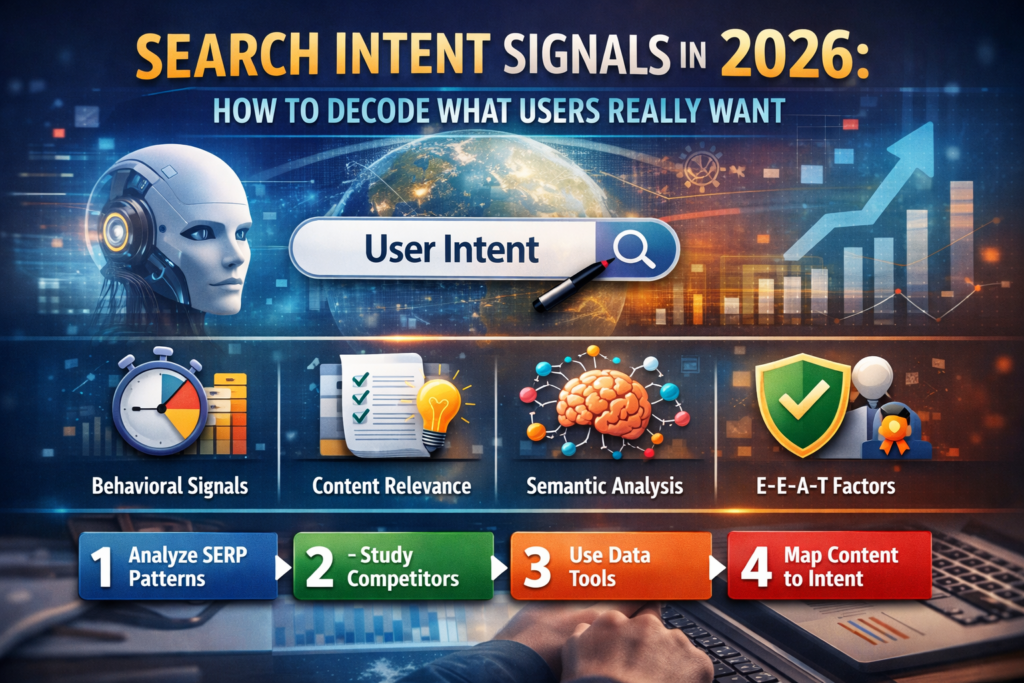
Core Search Intent Signals in 2026
To succeed with Search Intent Optimization 2026, focus on these measurable signals:
1. Behavioral Signals
Search engines evaluate:
- How long users stay on a page
- Whether they return to search results
- Interaction with internal links
Strong engagement indicates alignment with Search Intent Signals.
2. Content Depth & Context
AI models assess whether content fully answers a query. Thin content fails because it does not satisfy User Search Intent in SEO.
Include:
- Structured headings (H1, H2, H3)
- Clear summaries
- Supporting examples
- FAQs
3. Semantic Relevance
Search engines analyze topic relationships, not just keywords. Successful Search Intent Optimization 2026 requires:
- Related terms
- Natural language phrasing
- Context-driven explanations
- Industry-specific insights
4. Experience & Authority Indicators
E-E-A-T (Experience, Expertise, Authoritativeness, Trustworthiness) directly impacts intent satisfaction. Businesses should:
- Publish expert-driven content
- Share case examples
- Add author credentials
- Cite credible industry insights
How to Decode What Users Really Want
Step 1: Analyze SERP Patterns
Search your target keyword and observe:
- Featured snippets
- FAQs
- Video results
- AI-generated summaries
These elements reveal dominant Search Intent Signals.
Step 2: Study Competitor Content
Review top-ranking pages and evaluate:
- Content structure
- Depth of explanation
- Use of visuals
- FAQs included
This helps refine User Search Intent in SEO strategy.
Step 3: Use Data Tools
Leverage:
- Google Search Console
- Analytics platforms
- Heatmaps
These tools show real user behavior, strengthening Search Intent Optimization 2026.
Step 4: Map Content to Intent
For IT services:
- Blog posts → Informational intent
- Service pages → Transactional intent
- Case studies → Commercial investigation intent
Aligning content type with Search Intent Signals improves conversions.
Search Intent Optimization 2026 for IT Services
IT companies serving domestic and international clients must:
- Create intent-based landing pages
- Develop solution-driven blog clusters
- Optimize technical pages for clarity
- Address global search variations
For example:
A domestic business may search “IT support services near me,” while an international client may search “managed IT services provider.” Understanding User Search Intent in SEO ensures both audiences are effectively targeted.
Optimizing for SEO, AEO & GEO in 2026
SEO (Search Engine Optimization)
- Focus on topical authority
- Avoid keyword stuffing
- Use structured formatting
- Add internal linking
AEO (Answer Engine Optimization)
- Provide concise definitions
- Include FAQ sections
- Structure content clearly
- Use short, direct answers
GEO (Generative Engine Optimization)
- Offer contextual depth
- Include real-world insights
- Provide complete answers
- Maintain logical content flow
Combining these strategies strengthens Search Intent Optimization 2026 and improves visibility across traditional and AI-driven search platforms.
Common Mistakes to Avoid
- Writing for keywords instead of users
- Ignoring engagement metrics
- Publishing shallow content
- Overusing keywords unnaturally
- Failing to update outdated information
Effective User Search Intent in SEO requires ongoing refinement based on data and user behavior.
Future Outlook: Intent-First Digital Strategy
By 2026, ranking will depend less on technical manipulation and more on relevance, expertise, and satisfaction. Businesses that prioritize Search Intent Signals will outperform competitors relying solely on outdated keyword tactics.
The future belongs to brands that understand psychology, context, and user needs.
Conclusion
Search Intent Optimization 2026 is the foundation of modern digital success. Whether targeting domestic markets or international audiences, decoding User Search Intent in SEO and responding to evolving Search Intent Signals ensures higher visibility, stronger authority, and improved conversions.
In an AI-driven world, understanding intent is no longer optional — it is essential.