If you are a business owner, startup founder, or service provider in Kochi, Kerala, or across GCC markets like Qatar and the UAE, understanding the SEO vs AEO vs GEO future ranking strategy for Google in 2026 is no longer optional — it is the difference between growing your leads online and losing them to competitors who have already made the shift. Google search in 2026 does not work the way it did two years ago. Your potential customers are now getting answers directly from AI-generated panels at the top of the search page, and if your content is not structured to appear in those positions, your business is invisible to a significant share of daily search traffic — regardless of your traditional keyword rankings.
What Is the Difference Between SEO, AEO, and GEO?
These are not three separate marketing campaigns. They are three layers of the same modern search visibility system — and every business targeting Kerala and GCC audiences needs all three working together.
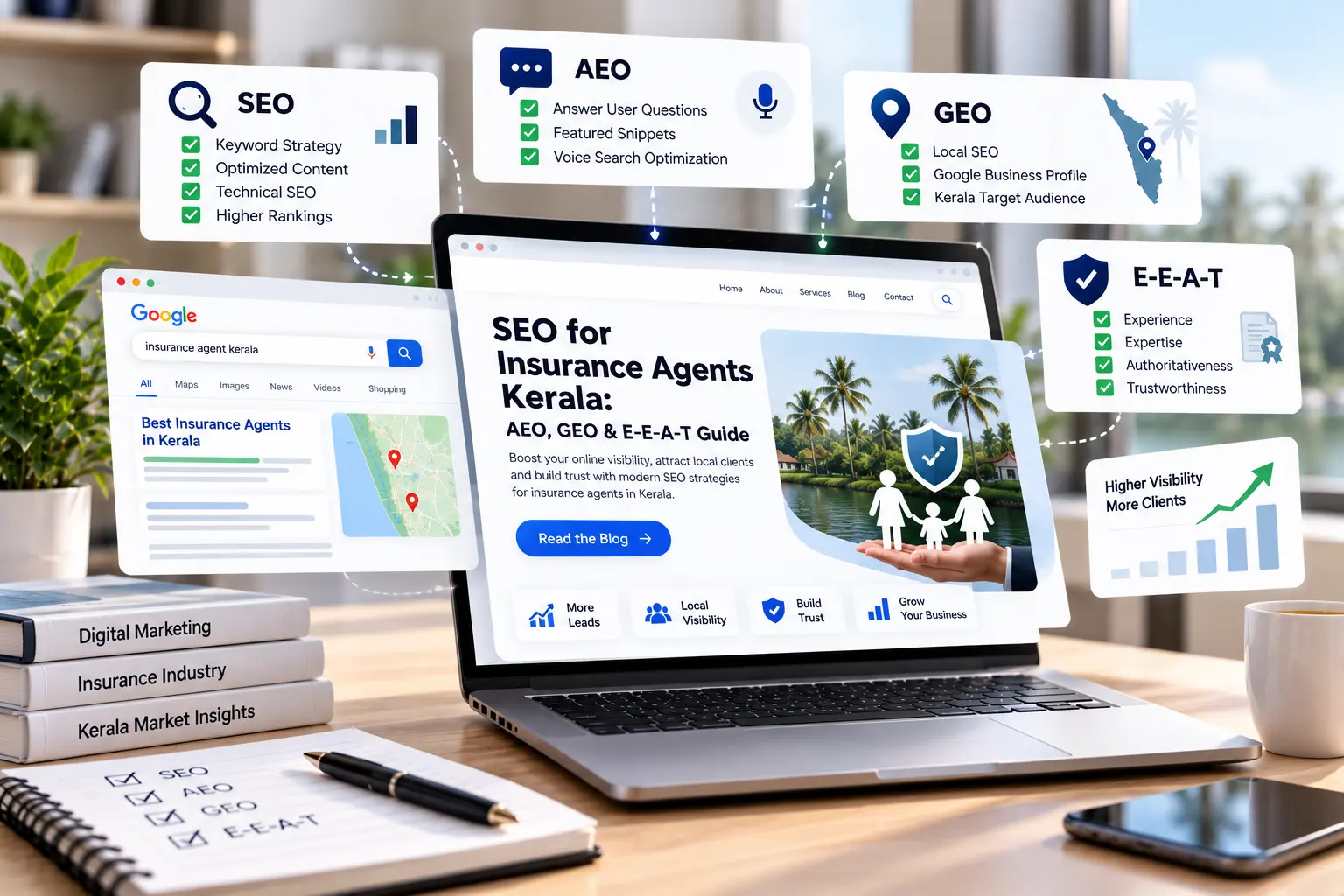
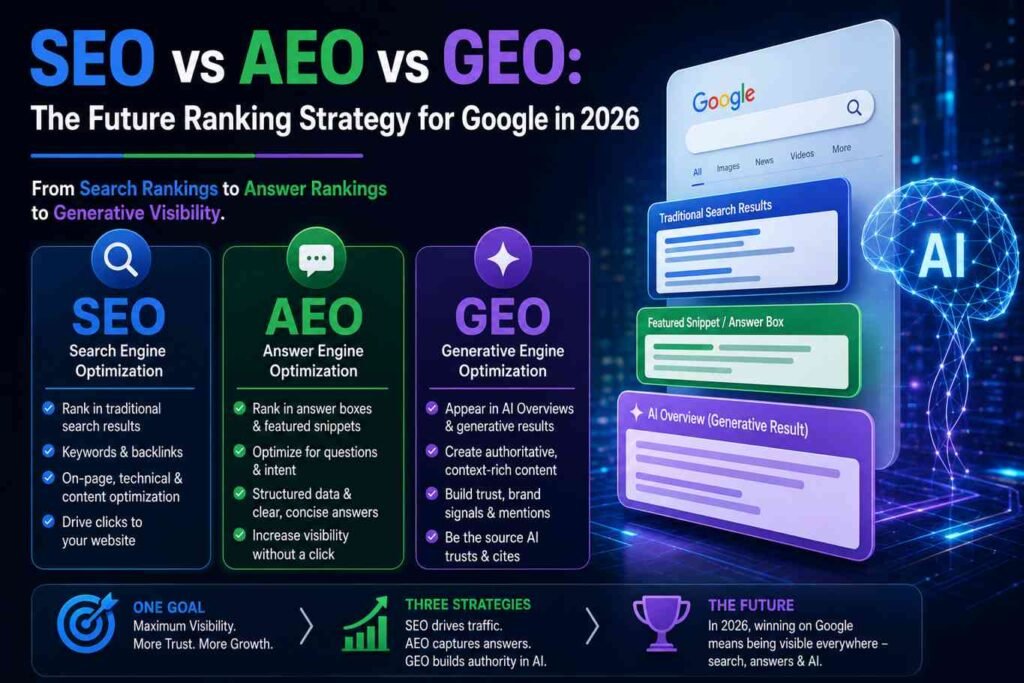
SEO (Search Engine Optimization) is the technical and content foundation. It ensures Google can crawl, index, and rank your website for relevant search queries through keyword optimization, backlinks, page speed, and site structure.
AEO (Answer Engine Optimization) is the practice of structuring your content so Google can extract and display your answers directly inside featured snippets, People Also Ask boxes, and AI Overview panels at the top of search results.
GEO (Generative Engine Optimization) is the newest and most important layer. It focuses on building enough credibility and content authority that Google’s AI systems actively cite and reference your website when generating AI-powered search responses.
Each layer addresses a different part of how Google now delivers information. Together, they determine your total search visibility in 2026.
Why Traditional SEO Alone Is No Longer Enough
Traditional SEO built the internet as we know it. Keyword research, backlinks, on-page optimization, technical audits — these strategies still matter and always will. But in 2026, the search results page has fundamentally changed.
The future of search engine optimization 2026 is being shaped by one dominant reality: zero-click searches. A growing majority of Google queries now return AI-generated answers, featured snippets, and knowledge panels that give users everything they need without clicking any website link. According to the latest SEO trends Kerala businesses should follow in 2026, businesses that fail to optimize for these answer positions are losing qualified traffic they cannot even measure because users never reach their pages at all.
For a restaurant in Ernakulam, a web design firm in Qatar, a signage company in Doha, or a freelance consultant in Kochi — the impact is direct. Every time a potential customer asks Google a question and gets an AI-generated answer that does not mention your business, you have lost a lead without knowing it.
What Has Changed in Google’s Ranking System
Google now processes search queries through a combination of traditional ranking algorithms and generative AI systems including Search Generative Experience and AI Overviews. These AI systems do not simply rank the highest-authority page — they evaluate content for clarity, structure, accuracy, and trustworthiness before selecting what to surface. Ranking in a traditional blue link position no longer guarantees your content will be selected for AI-generated answers. That requires AEO and GEO optimization specifically.
Understanding AEO: Answer Engine Optimization
AEO is not a tool or a platform. It is a content structuring discipline that makes your existing pages easy for Google to use as direct answer sources.
How AEO Works
When a user types or speaks a question into Google, the search engine scans indexed content for the most direct, clearly structured, and accurate answer available. Pages optimized for AEO are written so that answer is immediately accessible — without Google needing to interpret dense or ambiguous paragraphs.
AEO-optimized content includes:
- Question-based H2 and H3 headings that mirror real search queries
- A short direct answer of 40 to 60 words immediately following each question heading
- A detailed explanation paragraph below the direct answer for depth
- FAQ sections targeting People Also Ask queries
- FAQ schema markup to signal answer-eligible content to Google
- How-To schema for step-by-step process content
Why AEO Matters for Kerala and GCC Businesses
Consider the query: “best SEO strategy for small businesses in Kochi.” If a competitor’s page answers that question in a clean structured format and yours buries the answer inside five dense paragraphs, Google will display the competitor’s answer in the AI Overview — and your page receives zero visibility despite ranking on page one.
Learning how to appear in AI search answers before your competitor does is now one of the highest-priority tasks in any digital marketing investment in 2026. AEO is the strategy that makes it possible.
Understanding GEO: Generative Engine Optimization
GEO is the most significant new discipline within the SEO strategy for AI search results 2026 conversation, and for good reason. It changes the core question from “how do I rank in Google?” to “how do I become a source that Google’s AI trusts enough to cite in its generated answers?”
What GEO Actually Means
When Google’s AI generates a response to a complex query, it does not invent information. It pulls from indexed web content it has evaluated as credible, accurate, and genuinely authoritative. GEO optimization is the practice of building those trust signals so your website becomes one of the sources AI systems cite.
GEO optimization focuses on:
- Publishing original research, verified data, and firsthand case studies
- Citing credible external sources within your content to demonstrate accuracy
- Demonstrating genuine subject matter expertise through detailed experience-backed writing
- Building a consistent content structure that AI models can easily parse and reference
- Earning mentions and citations from other authoritative websites in your niche
- Keeping content current, factually accurate, and regularly updated
GEO vs Traditional SEO: The Core Difference
Traditional SEO asks: how do I get Google to rank my page in search results?
GEO asks: how do I get Google’s AI to trust my content enough to cite it in an AI-generated answer?
The second question requires a fundamentally different approach to content creation. Surface-level blog posts built around keyword density alone will not pass GEO evaluation. Detailed, experience-backed, well-cited content written by genuine experts will. For businesses in Kochi and GCC markets, GEO is the layer that determines whether your brand appears inside AI-generated answers reaching thousands of daily users who may never see a traditional search results page at all.
The Role of E-E-A-T Across SEO, AEO, and GEO
Experience, Expertise, Authoritativeness, and Trustworthiness — E-E-A-T — is the single quality framework that ties all three strategies together. Google’s systems, both traditional algorithms and generative AI models, evaluate your content against E-E-A-T signals to decide whether your website deserves to rank, be featured in answer boxes, or be cited in AI-generated responses.
How E-E-A-T Applies Across Each Layer
For SEO, E-E-A-T signals include authoritative backlinks, verified author credentials, consistent NAP data across directories, and strong technical site health.
For AEO, E-E-A-T means your answers must come from a source Google considers knowledgeable enough to trust. Generic or vague answers from anonymous sources are not featured. Detailed, accurate answers from credible experts are.
For GEO, E-E-A-T is the primary filter. AI systems will not cite sources they cannot verify as genuine and authoritative. Your website needs to demonstrate real expertise through your content, author bios, external citations, detailed case studies, and consistent topical coverage over time.
For businesses in Kerala and GCC markets, local E-E-A-T signals matter equally. Your Google Business Profile must be fully optimized with consistent business information, and your content should reflect genuine knowledge of local market conditions. An SEO expert in Kochi understands that local E-E-A-T requires both global best practices and region-specific authority signals working together.
How SEO, AEO, and GEO Work Together: A Practical Framework
The most important mindset shift is treating these three strategies as one integrated system rather than separate campaigns.
Layer 1 — SEO: Build the Technical Foundation
Without technically sound SEO, neither AEO nor GEO can perform. Your website must be crawlable, mobile-optimized, fast-loading, and well internally linked. Target the right keywords with proper on-page optimization and build a backlink profile that signals authority. This is the non-negotiable base everything else rests on.
Layer 2 — AEO: Capture Direct Answer Positions
Once your technical foundation is solid, every piece of content you publish should be structured to answer the specific questions your target audience is actively searching. Move away from essay-style blog posts toward structured content that leads with direct answers, uses question-based headings, and includes FAQ sections with schema markup applied.
Layer 3 — GEO: Become a Trusted AI Citation Source
The final layer requires investing in content quality over content volume. Original research, detailed case studies, expert commentary, and well-cited statistics signal to Google’s AI systems that your website is a reliable source worth referencing. Businesses that consistently publish expert-level content across their core service topics build the kind of GEO authority that results in AI Overview citations and generative search visibility that competitors cannot easily replicate.
A freelance SEO expert in Kochi who works across all three layers can build a content strategy that simultaneously improves traditional rankings, captures answer positions, and grows AI citation authority — all from the same content investment.
A Real-World Example for Kerala and GCC Businesses
Consider a web design company based in Kochi targeting both local Kerala clients and GCC markets. Their traditional SEO is decent — they rank on page one for a few keywords. But their blog posts are generic, do not directly answer questions, and contain no original data or case studies.
In 2026, this means:
- They miss all featured snippet positions because their content is not AEO-structured
- They are not cited in AI Overview responses because their content lacks GEO authority signals
- Their organic traffic slowly declines as more users receive answers directly from AI panels
Now compare this to a competitor who publishes detailed, expert-led content answering specific questions like “How much does a website cost in Qatar?” or “What is the difference between SEO and AEO for small businesses?” — with original data, schema markup, and a credible author bio.
That competitor appears in featured snippets, gets cited in AI Overviews, and generates leads from users who never scroll past the first result. Understanding how to appear in AI search answers and acting on it early is what separates growing businesses from stagnant ones in 2026.
Knowing what your site visitors do after they arrive is equally critical. Website heatmap analysis for Kerala businesses reveals exactly how users interact with your content — helping you identify which pages need AEO restructuring and which sections are already converting well.
Frequently Asked Questions
What is the difference between SEO and AEO?
SEO focuses on ranking your web pages in traditional search results through technical optimization, keywords, and backlinks. AEO focuses on structuring your content so Google can extract and display it as a direct answer in featured snippets, People Also Ask boxes, and AI Overviews. In 2026, both are necessary — SEO gets you into the index, AEO gets you into the answer.
What is GEO and why does it matter in 2026?
GEO, or Generative Engine Optimization, is the practice of making your content credible and authoritative enough for Google’s AI systems to cite it when generating AI-powered search responses. It matters because an increasing share of Google queries now return AI-generated answers rather than traditional blue links. Businesses that appear inside those AI answers gain brand visibility and trust that traditional rankings alone cannot deliver.
How does E-E-A-T affect rankings in 2026?
E-E-A-T is Google’s quality evaluation framework covering Experience, Expertise, Authoritativeness, and Trustworthiness. In 2026 it influences not just traditional rankings but also which content gets selected for featured snippets and AI Overview citations. Businesses with strong E-E-A-T signals through verified expertise, consistent content quality, and credible author credentials perform better across all three layers of SEO, AEO, and GEO.
Can small businesses in Kerala compete in AI search results?
Yes. AI search results favor content quality and genuine expertise over domain age or budget size. A small business in Kochi that consistently publishes well-structured, expert-led content answering specific local and industry questions can outperform larger competitors in featured snippets and AI Overviews. The key is investing in the right content strategy rather than content volume alone.
How do I start implementing AEO and GEO for my business?
Start with a content audit to identify pages that can be restructured with question-based headings and FAQ sections. Add FAQ schema markup to your most relevant service and blog pages. Then build a content calendar focused on original, expert-level articles that directly answer questions your target audience is searching. If you are targeting both Kerala and GCC markets, ensure your content addresses both local and regional search intent. Working with a qualified SEO consultant in Kochi who understands all three layers will significantly accelerate this process.
The Bottom Line: Three Layers, One Winning Strategy
The future of search engine optimization 2026 belongs to businesses that stop treating SEO as a single tactic and start treating it as a three-layer system. Traditional SEO builds your foundation. AEO captures direct answer visibility. GEO earns AI citation authority. E-E-A-T ties all three together into a coherent strategy that compounds over time.
For business owners, startups, and service providers in Kochi, Kerala, and across GCC markets, the question is not whether to adopt this framework. It is how quickly you implement it before your competitors do. The businesses executing this SEO strategy for AI search results 2026 today are building a search presence that generates qualified leads from multiple surfaces simultaneously — traditional rankings, featured snippets, and AI-generated answers — and becomes increasingly difficult for competitors to displace.
That is not just better SEO. That is sustainable competitive advantage in the Google of 2026.