If you run a business in Kochi and have invested in SEO without seeing real results, there’s a good chance your website is missing one critical piece: Entity SEO. While most businesses are still chasing keywords, Google has quietly shifted toward understanding entities — real-world things, people, places, and concepts — and how they relate to each other. Businesses that ignore this shift are losing visibility to competitors who have aligned their websites with how modern search engines actually work.
In this guide, we’ll break down what Entity SEO really means, why it matters more than ever, and how you can start applying an entity-based SEO strategy to your own business website.
What Is Entity SEO
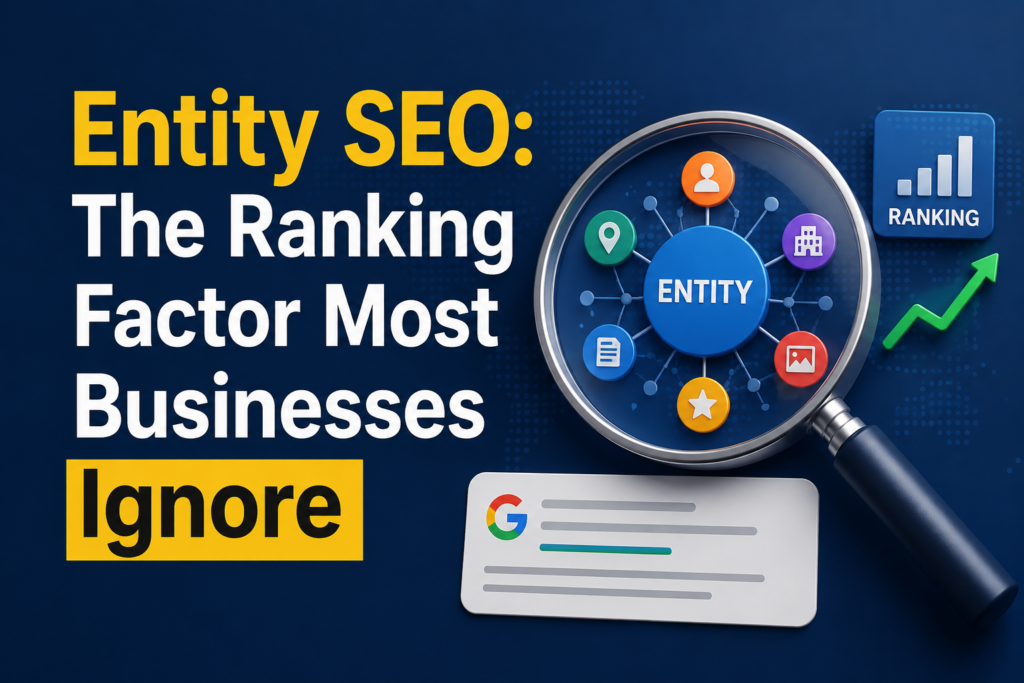
Entity SEO is the process of helping search engines clearly identify your business, brand, products, services, and the people behind them as distinct, verified “entities” within Google’s Knowledge Graph. Instead of just matching keywords on a page, Google now tries to understand:
- Who you are
- What you do
- Where you operate
- How trustworthy and authoritative you are in your space
Think of it this way: keywords tell Google what a page is about. Entities tell Google what a page, business, or person actually is. A bakery in Kochi isn’t just a collection of keywords like “best bakery Kochi.” It’s a real, physical business with a name, address, phone number, owner, reviews, and relationships to other entities — suppliers, local landmarks, and customer communities.
Why Entity SEO Matters More Than Ever
Search engines have moved away from simple text matching toward semantic understanding. Google’s algorithms rely heavily on the Knowledge Graph, a massive database connecting people, places, organizations, and concepts.
When your business is recognized as a verified entity, Google can confidently display your information in:
- Search results and local packs
- Knowledge panels
- Voice search responses
- “People also ask” sections
This is directly tied to Google E-E-A-T signals — Experience, Expertise, Authoritativeness, and Trustworthiness. An entity-based SEO strategy is essentially how you build and prove these signals at scale. If you’re unsure where your site currently stands, our SEO audit service can help identify gaps in your entity profile.
How Entity SEO Differs From Traditional Keyword SEO
Traditional SEO focuses on optimizing individual pages around specific search terms. You pick a keyword, place it through your content, build some backlinks, and hope for the best. This still has value — but on its own, it’s incomplete.
Entity SEO works at a higher level. It focuses on building a consistent, recognizable identity across the web, including:
- How your business name, address, and phone number (NAP) appear across directories
- How your team is represented on LinkedIn and your website
- How your brand is mentioned on other authoritative sites
- How your content demonstrates real expertise rather than keyword stuffing
A business that ranks well today combines both: solid on-page optimization (see our on-page SEO services) paired with a strong entity presence that signals authority to Google.
Key Components of an Entity-Based SEO Strategy
1. Structured Data and Schema Markup
Adding schema for your organization, local business, services, reviews, and FAQs helps search engines understand exactly what each piece of content represents — rather than guessing based on text alone.
2. Consistent NAP Information
Your business Name, Address, and Phone number should match exactly across your website, Google Business Profile, and online directories. This confirms your business as a single, verified entity rather than fragmented or duplicate listings.
3. Google Business Profile Optimization
A well-maintained Google Business Profile is essential for businesses targeting Kochi and surrounding areas. This is often the first place Google pulls entity information from for local searches. Our local SEO services in Kochi focus heavily on this.
4. Author Bios and Team Pages
When you publish content, attaching it to a real person with credentials, experience, and an online presence strengthens E-E-A-T signals and helps Google associate expertise with your brand.
5. Backlinks and Brand Mentions
Backlinks and mentions from authoritative, relevant websites act as votes of confidence that reinforce your entity’s credibility. Our link building services are designed specifically to build this kind of contextual authority.
6. Internal Linking and Topical Clusters
When your website covers a topic thoroughly — with interconnected pages around related subtopics — Google sees this as a sign of genuine expertise rather than a single thin page trying to rank for a keyword. If you’d like to dive deeper, check out our related post on why local SEO matters for small businesses.
Why Local Businesses in Kochi Should Pay Attention
For businesses operating in Kochi, entity SEO is particularly powerful because local search results depend heavily on Google’s confidence in matching a business to a specific location, category, and set of services.
If your entity signals are weak or inconsistent, you may struggle to appear in the local pack — even if your website is well-optimized for keywords.
To strengthen your entity presence:
- Ensure your business is accurately listed across local directories
- Keep your Google Business Profile complete and regularly updated
- Encourage and respond to customer reviews
- Make sure your website content reflects genuine local expertise — mentioning specific neighborhoods, landmarks, or community involvement
For a deeper look, read our guide on Google Business Profile optimization tips for Kerala businesses.
How to Get Started With Entity SEO
If this is new to your business, here’s a simple roadmap:
- Audit your current presence — search your business name and check for inconsistencies in your address, phone number, or category.
- Claim and fully optimize your Google Business Profile.
- Add structured data to your website, starting with organization and local business schema.
- Build out author profiles for anyone creating content on your site, including credentials and links to professional profiles.
- Earn mentions and backlinks from credible local and industry-relevant websites.
If you’d rather have experts handle this for you, our team offers a complete digital marketing package for businesses in Kochi that includes entity SEO as a core component.
Frequently Asked Questions
1. What is the difference between Entity SEO and traditional SEO? Traditional SEO focuses on optimizing pages for specific keywords. Entity SEO focuses on building a consistent, verifiable identity for your business across the web so Google understands who you are, not just what your pages say.
2. How does Entity SEO improve E-E-A-T? Entity SEO strengthens E-E-A-T by connecting your brand, team members, and content to verified, authoritative sources — proving your experience, expertise, authority, and trustworthiness to Google.
3. Is Entity SEO important for small local businesses? Yes. For local businesses, especially in competitive areas like Kochi, entity signals directly impact whether you appear in Google’s local pack and Maps results.
4. How long does it take to see results from Entity SEO? Entity SEO is a long-term strategy. Most businesses start seeing improvements in local visibility and rankings within 2-4 months of consistent implementation.
5. Do I need schema markup for Entity SEO? Yes, schema markup is one of the most direct ways to communicate entity information to search engines and is considered a foundational step.
Final Thoughts
Entity SEO is not a replacement for traditional SEO — it’s the layer most businesses overlook. As search engines become better at understanding real-world relationships between businesses, people, and content, brands that invest in building a clear, consistent, and trustworthy entity presence will win visibility, especially in competitive local markets like Kochi.
If your competitors are still focused only on keywords while you build a strong entity foundation, you give your business a long-term advantage that’s difficult to replicate overnight.
Ready to strengthen your entity profile? Get in touch with our SEO team for a free consultation.