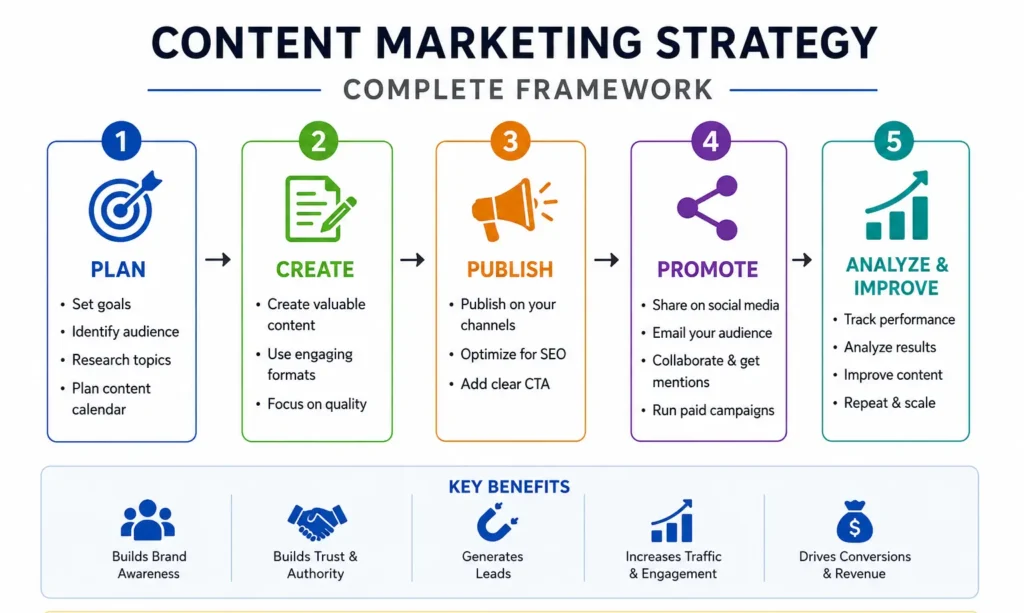
Most businesses aren’t struggling because they lack content. They’re struggling because they lack a content marketing strategy that ties everything together. Publishing blog posts, social updates, and videos without a clear plan wastes time and rarely moves the needle on traffic, leads, or sales.
For business owners, startups, and entrepreneurs in Kochi and across Kerala, a solid content marketing strategy is what turns scattered content efforts into a predictable system for attracting and converting customers. This guide walks through a complete framework you can actually follow, from setting goals to measuring results.
If you haven’t yet built the search visibility foundation your content needs to succeed, it helps to pair this with a broader look at how to grow your online presence through SEO and digital marketing on the Sanal Edison blog, where several related guides break down each piece in more depth.
What Is a Content Marketing Strategy?
A content marketing strategy is a documented plan that defines why you create content, who it’s for, what formats you’ll use, where you’ll publish and promote it, and how you’ll measure success. It’s different from simply “doing content marketing,” which often means posting without direction.
Think of it as the difference between wandering through a city without a map versus following turn-by-turn directions to a specific destination. Both involve movement. Only one gets you somewhere on purpose.
Why You Need a Content Marketing Framework for Businesses
A content marketing framework for businesses matters because it removes guesswork. Instead of asking “what should we post this week,” your team works from a plan that already answers what, why, and for whom.
Businesses that follow a structured framework typically see three benefits over time:
- Content that consistently supports business goals instead of existing for its own sake
- Easier decision-making, since every content idea gets filtered through the same strategic questions
- Compounding results, since each piece of content builds on previous work instead of starting from zero
How to Create a Content Marketing Strategy Step by Step
Knowing how to create a content marketing strategy step by step keeps the process manageable, even for a small team or a solo business owner. Here is the sequence that works well in practice.
Step 1: Define Your Goals and Audience
Start by getting specific about what you want content to achieve. Vague goals like “increase brand awareness” are hard to measure. Specific goals like “generate 50 qualified leads per month through blog content” give your strategy direction.
Alongside goals, build a clear picture of your audience: their problems, their questions, and where they spend time online. If you’re a local business, understanding how Kochi customers search and behave matters just as much as national trends do.
Step 2: Audit Your Existing Content
Before creating anything new, review what you already have. Identify content that’s performing well, content that’s outdated, and gaps where you have no content at all. This audit often reveals quick wins, like updating an old post instead of writing a new one from scratch.
Step 3: Choose Your Content Types and Formats
Different goals call for different formats. Understanding the types of content marketing available helps you match format to purpose rather than defaulting to blog posts for everything.
Common types include:
- Blog articles and long-form guides for organic search visibility
- Video content for engagement and platforms like YouTube
- Case studies and testimonials for building trust with prospects
- Email newsletters for nurturing existing leads
- Social media posts for reach and community building
- Infographics and data visuals for shareability
Step 4: Build a Content Calendar
A content calendar keeps your team consistent and accountable. It should map out topics, formats, target keywords, publish dates, and who owns each piece. Without this, content production tends to slow down or stop entirely once the initial motivation fades.
Step 5: Create and Optimize Content
This is where writing, filming, and designing happens. Every piece should be built around a clear purpose and optimized for both readers and search engines. Strong on-page optimization, natural keyword usage, and genuine expertise all matter here, which is why many businesses lean on professional content support rather than producing everything in-house.
Step 6: Distribute and Promote
Publishing content isn’t the finish line. A content distribution strategy determines whether your content actually reaches your audience. This includes email lists, social channels, communities, and occasionally paid promotion to accelerate reach for your best-performing pieces.
Step 7: Measure, Learn, and Adjust
Review performance regularly and adjust based on what the data shows, not assumptions. This step turns content marketing from a one-time project into an ongoing, improving system.
Content Marketing Plan Step by Step for Small Businesses
A content marketing plan step by step approach looks a little different for small businesses than for large enterprises, mainly because of resource constraints. Content marketing for small business works best when it’s focused rather than broad.
Rather than trying to be active on every platform, small businesses generally get better results by:
- Picking one or two content formats they can sustain consistently
- Focusing on topics with clear local or niche relevance
- Repurposing one piece of content into multiple formats instead of creating everything from scratch
- Prioritizing quality and consistency over sheer volume
This mirrors the same principle behind authentic content marketing, where real experience and a genuine voice consistently outperform generic, templated content. There’s a deeper look at why authenticity wins in content marketing on the Sanal Edison blog, which pairs well with the planning steps above.
B2B Content Marketing Strategy Considerations
A B2B content marketing strategy differs from consumer-focused content in a few important ways. B2B buyers typically research longer, involve multiple decision-makers, and respond better to educational, data-driven content than to purely promotional material.
Effective B2B content often includes:
- In-depth guides and whitepapers that address specific business problems
- Case studies showing measurable results with real numbers
- LinkedIn-focused thought leadership content
- Webinars and demos that support longer sales cycles
Setting Content Marketing Goals and KPIs
Clear content marketing goals and KPIs are what separate a strategy from a hobby. Common KPIs worth tracking include organic traffic growth, keyword rankings, time on page, lead form submissions, email signups, and ultimately, conversions or sales tied back to specific content.
It’s worth checking these metrics against your site’s technical health too, since even great content underperforms on a slow or poorly structured website. A quick review using a technical SEO audit checklist can reveal issues that are quietly limiting your content’s reach.
Content Marketing vs SEO: How They Work Together
A common point of confusion is content marketing vs SEO, as if you have to choose one. In reality, they’re two halves of the same engine. Content marketing focuses on creating valuable material for your audience. SEO focuses on making sure that material can actually be found in search results.
Content without SEO often gets buried, no matter how good it is. SEO without quality content has nothing worth ranking. A related piece on local SEO strategy for Kochi businesses shows how these two disciplines combine for location-based businesses specifically.
Content Marketing Best Practices 2026
A few content marketing best practices 2026 are worth building into your framework from day one:
- Lead with genuine experience and original insight, since AI-generated, generic content is becoming easier for both readers and search engines to spot
- Optimize content for both traditional search and AI-driven answer engines, since tools like Google AI Overviews and ChatGPT increasingly summarize and cite web content
- Update and refresh older content regularly instead of only publishing new material
- Build internal links between related content to strengthen topical authority across your site
- Treat video and short-form content as a core channel, not an afterthought, given how much search behavior has shifted toward it
Frequently Asked Questions
1. How long does it take to see results from a content marketing strategy?
Most businesses start seeing meaningful traffic and lead growth within three to six months of consistent publishing, though timelines vary based on competition and content quality.
2. What’s the difference between a content strategy and a content calendar?
A content strategy is the overall plan covering goals, audience, and approach. A content calendar is a scheduling tool that organizes when and what gets published, based on that strategy.
3. Do small businesses really need a formal content marketing strategy?
Yes. Even a simple, one-page strategy prevents wasted effort and keeps content aligned with actual business goals, which matters even more when time and budget are limited.
4. How many types of content marketing should a business use?
Most businesses do well focusing on two or three content types they can maintain consistently, rather than spreading thin across every possible format.
5. Is content marketing still effective with the rise of AI-generated content?
Yes, but the bar has risen. Content built on genuine expertise, original data, or real experience continues to outperform generic or purely AI-written material, both for readers and for search visibility.
Final Thoughts
A strong content marketing strategy isn’t about producing more content. It’s about producing the right content, for the right audience, distributed through the right channels, and measured against clear goals. Following this framework step by step turns content from a scattered task into a genuine growth engine for your business.
If you’d like help building or executing a content marketing strategy tailored to your business, feel free to get in touch for a free consultation, or browse more strategies on the SEO and digital marketing blog.